
PVC Pipeline Fabrication and Erection in Industrial Sites: The Complete Guide. Let’s be honest. When most people think about industrial sites, they imagine massive steel structures, towering cranes, and sparks flying from welding torches. PVC pipeline fabrication and erection rarely get the spotlight. But here’s the thing – without it, industrial facilities wouldn’t function. No water. No chemicals. No drainage. Nothing.
PVC pipeline fabrication companies in Saudi Arabia are the quiet heroes keeping factories running, plants operating, and industrial processes flowing. They’re not glamorous. They don’t make headlines. But try running an industrial facility without proper piping systems. Good luck with that.
I once visited a petrochemical plant in Jubail where a senior engineer gave me a tour. We walked past miles of pipes, and he stopped at a section of large-diameter PVC pipeline. He tapped it and said, “This ‘cheap plastic’ carries acids that would eat through steel in months. It’s been here fifteen years. Not a single leak.” That stuck with me. Because he was right. PVC in industrial settings isn’t just plumbing. It’s engineering.
This article covers everything you need to know about PVC pipeline fabrication and erection in industrial sites. From manufacturing to installation, from joining methods to testing. And if you need reliable fabrication services, check out Fabrication KSA for your project needs. Let’s keep it simple, practical, and maybe share a few laughs along the way.
Understanding PVC Pipeline Systems for Industrial Applications
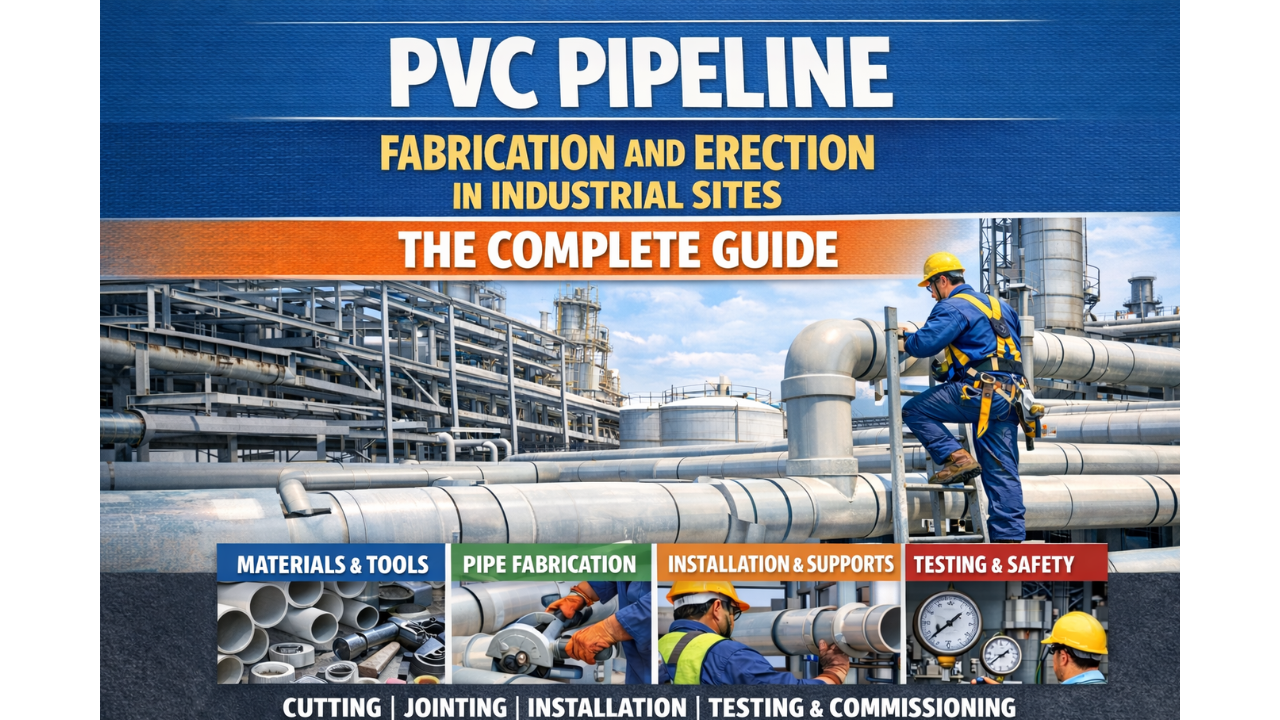
H2: What Makes PVC Suitable for Industrial Use
PVC, or polyvinyl chloride, isn’t your average plastic. Industrial-grade PVC is specifically formulated to handle tough conditions. It resists chemical corrosion, doesn’t rust like metal, and stands up to harsh environments.
Think about what industrial pipes go through. High pressure. Temperature fluctuations. Aggressive chemicals. Abrasive materials. PVC handles all of this when properly selected and installed. That’s why industries from petrochemicals to food processing rely on PVC pipe work in Jeddah and across the Kingdom.
The material properties are impressive. PVC pipes have smooth inner surfaces that prevent scaling and accumulation. This means efficient fluid flow and less maintenance. They’re also lightweight compared to metal alternatives, making handling and installation easier on industrial sites.
For industrial applications, you might encounter different types. Standard PVC for general use. CPVC (chlorinated PVC) for higher temperatures. PVC-O (oriented PVC) for high-pressure applications where you need the mechanical properties approaching metals. Each has its place in industrial settings.
H2: The Industrial Applications of PVC Pipelines
When we talk about industrial sites, we’re referring to a wide range of applications. Water supply networks for plant operations. Chemical transfer lines. Compressed air systems. Drainage and effluent disposal. Fire protection systems. The list goes on.
For example, consider a typical industrial facility. It needs potable water for workers and facilities. It needs process water for manufacturing. It needs cooling water for the equipment. It needs wastewater removal. All of these can use PVC water pipe work in Jeddah, Saudi Arabia, when designed correctly.
The oil and gas sector in Saudi Arabia is increasingly using PVC pipes for specific applications. So do mining operations, desalination plants, and food processing facilities. The versatility of PVC makes it valuable across industries. And with the Kingdom’s focus on industrial diversification under Vision 2030, demand for reliable piping systems continues to grow.
The Saudi Arabia PVC pipes market reached about USD 982-1,309 million in 2024 and is expected to grow significantly. That growth comes from industrial expansion, not just residential construction.
PVC Pipe Manufacturing: Where It All Begins
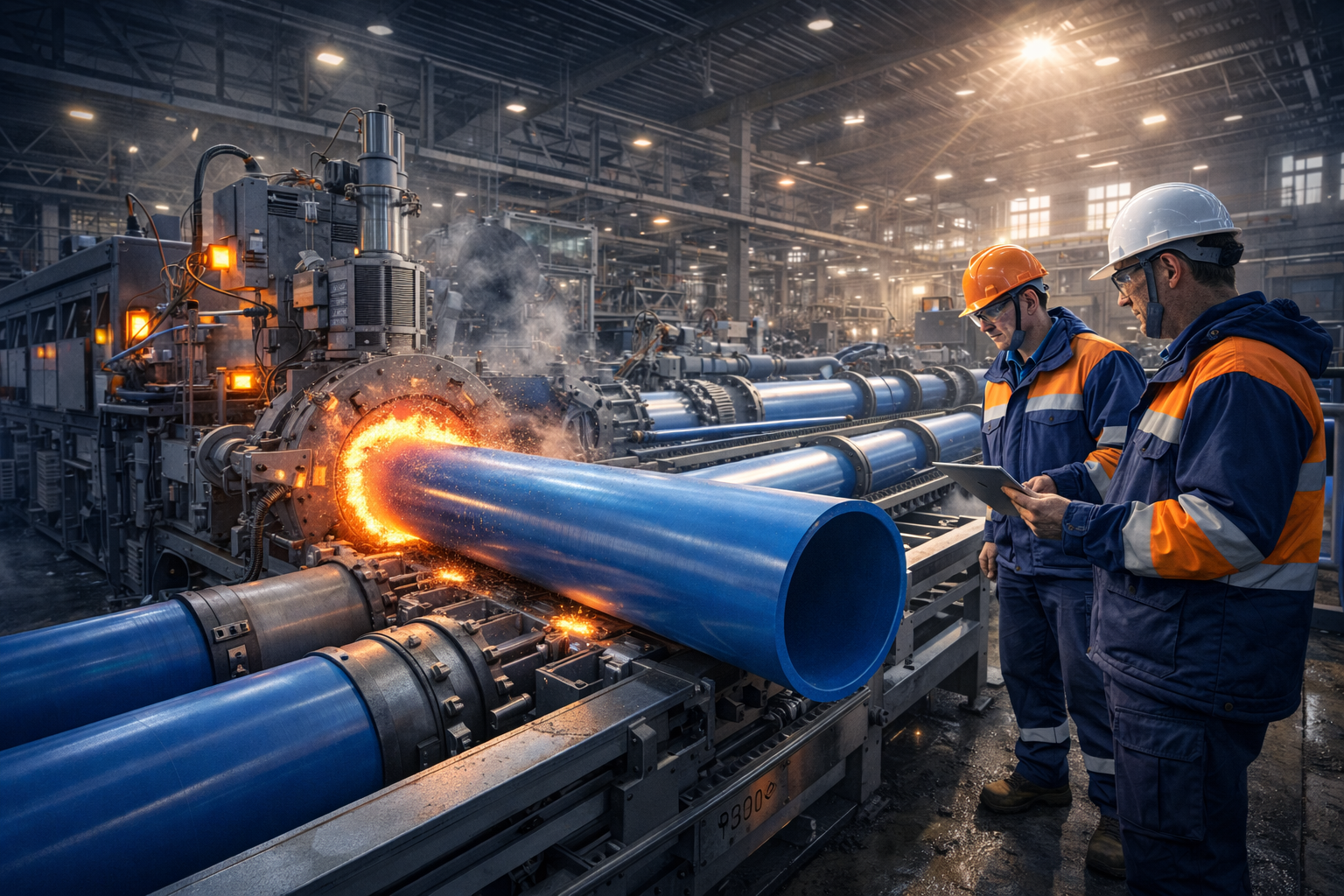
H2: The Manufacturing Process
Before any pipe is installed on an industrial site, it must be manufactured. The process might seem straightforward, but it requires precision and quality control. PVC pipeline fabrication companies start with raw materials and turn them into finished products through several steps.
The basic process goes like this: Raw materials (PVC resin and additives) are fed into a high-speed mixer. The mixed material feeds into an extruder, where heat and pressure melt it into a consistent flow. The molten PVC passes through a die that shapes it into a pipe. Then comes cooling in water baths, cutting to length, and quality testing.
But here’s what most people don’t realize. The quality of the finished pipe depends entirely on control at every step. The temperature must be precise. Pressure must be consistent. Cooling must be uniform. If any step goes wrong, the pipe fails.
Leading manufacturers like Neproplast, established in 1968 as the first PVC pipe company in Saudi Arabia, now operate 144 production lines with an annual capacity exceeding 200,000 metric tons. They produce pipes ranging from small diameters for plumbing to 710mm for industrial mains.
Quality Control and Standards
Quality isn’t optional in industrial applications. When a pipeline carries hazardous chemicals or operates under high pressure, failure isn’t an option. That’s why reputable PVC pipe manufacturers in Saudi Arabia maintain rigorous quality control.
Neproplast operates three quality control laboratories 24/7, testing all production and raw materials against Saudi and international standards. Their certifications include ISO 9001:2015, SASO, UL 651, NSF, FM 1316, and WRAS. That’s not just alphabet soup – each certification represents independent verification of quality.
For industrial buyers, checking certifications matters. When you’re looking for a PVC pipe contractor in Saudi Arabia for an industrial project, ask about the source of their materials. Reputable contractors work with reputable manufacturers. They can show you certifications and test reports.
Al Watania Plastics, another major player since 1982, performs daily quality checks in its own laboratory. They’ve supplied millions of tonnes of plastic products to clients, including Saudi Telecom, electrical companies, and government agencies. That track record means something.
Fabrication: Customizing Pipe for Industrial Needs
What Fabrication Actually Means
Here’s where things get interesting. Manufacturing produces straight pipes in standard lengths. Fabrication modifies those pipes for specific applications. Cutting, joining, adding fittings, and creating custom configurations. PVC pipeline fabrication is what turns raw pipe into a working system.
For industrial sites, standard pipes rarely fit perfectly. You need elbows for direction changes. Tees for branch lines. Reducers for diameter changes. Flanges for connections to equipment. Fabrication creates these components or assembles them into larger units.
Neproplast even maintains a dedicated pipes-and-fittings fabrication facility to customize products to meet specific customer requirements. That’s the level of capability needed for complex industrial projects.
When you need PVC pipe work in Jeddah for an industrial facility, fabrication might involve prefabricating spool pieces in a shop for later installation on site. This approach improves quality control and speeds up field installation.
Common Fabrication Techniques
Fabrication isn’t just assembly. It involves specific techniques that must be done correctly for the system to perform. Here are the main methods used in industrial fabrication:
- Cutting – Pipes must be cut cleanly and squarely. For industrial work, this means using fine-tooth saws (manual or power) that create smooth edges without cracking the material. Burrs must be removed completely.
- Joining – Several joining methods exist for PVC pipelines. Solvent welding is most common for smaller diameters. The process involves cleaning surfaces, applying primer and cement, and inserting the pipe with a twisting motion. Proper technique creates a bond as strong as the pipe itself.
- For larger diameters, push-on joints with rubber gaskets are often used. These allow for some movement and easier assembly in the field. The gasket must be properly seated and lubricated.
- Flanging – For connections to valves, pumps, and equipment, flanges are often the best choice. A flange adapter is solvent-welded to the pipe end, then bolted to a mating flange with a gasket between.
- Threading – PVC can be threaded for certain applications, though this reduces the pressure rating. Thread seal tape (PTFE) must be used; never pipe dope or hemp.
Erection: Installing PVC Pipelines on Industrial Sites
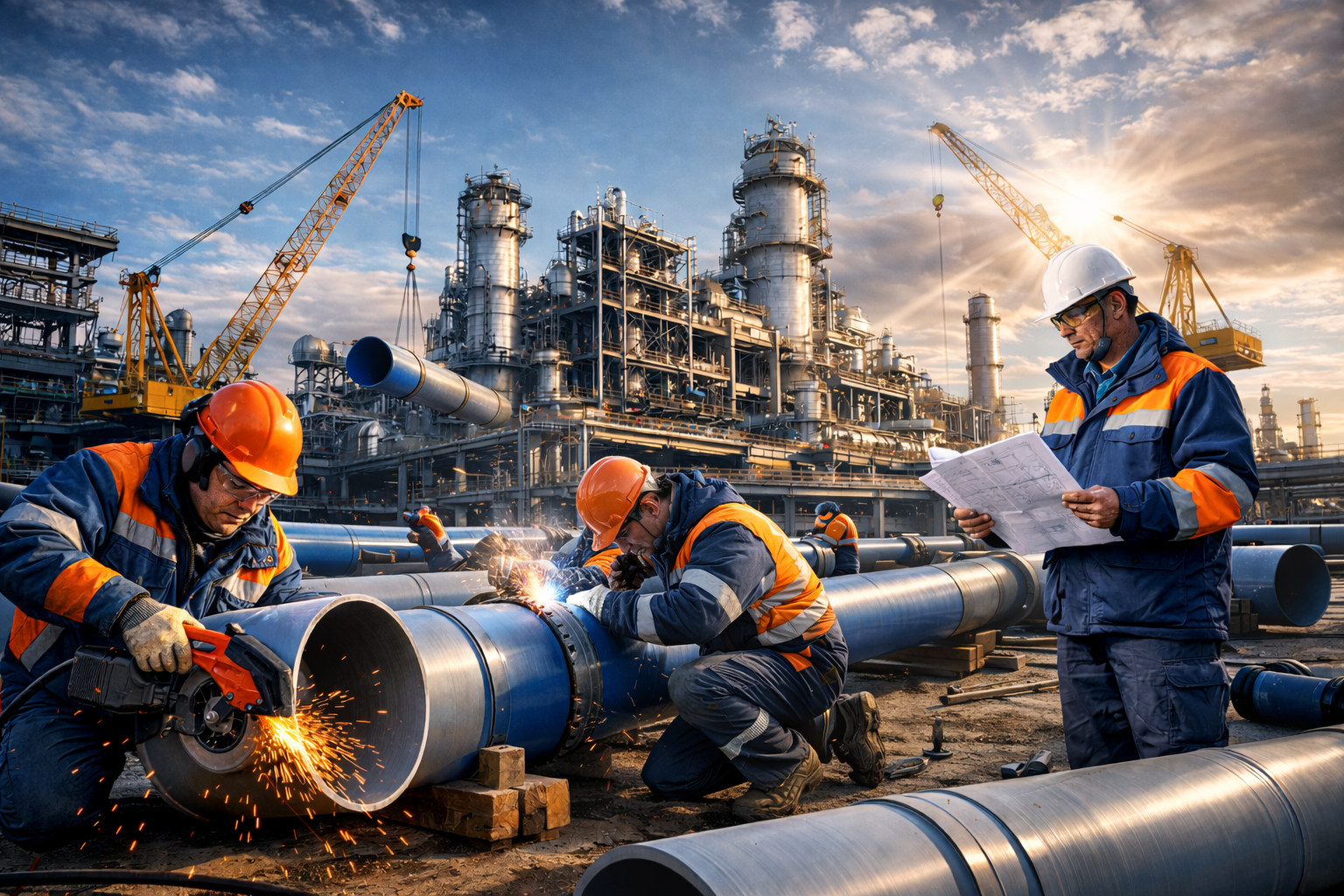
Preparation and Planning
Erection is where fabrication meets the real world. Industrial sites are busy, crowded, and challenging. PVC pipeline erection requires careful planning before any pipe is installed.
First, survey the site. Locate existing underground utilities that might conflict with new lines. Industrial sites often have complex networks of existing services – electrical, communication, and other pipelines. Hitting one during excavation causes delays and danger.
Next, plan the installation sequence. Large industrial projects might involve thousands of meters of pipe. You can’t install everything at once. You need a logical sequence that works with other trades and doesn’t create impossible situations.
For underground installation, trench preparation is critical. The trench bottom must be properly prepared with appropriate bedding material. For PVC, this typically means sand or fine gravel compacted to the specified density. Poor bedding leads to pipe settlement and joint stress.
Installation Best Practices
When installation begins, attention to detail separates good work from problems. Here’s what proper PVC pipe work in Jeddah, Saudi Arabia, looks like on industrial sites:
Pipe handling – PVC can be damaged by rough handling. Don’t drop pipes. Don’t drag them across rough ground. Inspect each pipe before installation for cracks or damage that may have occurred during transport.
- Cleanliness – Keep pipe interiors clean during installation. Dirt, debris, or joint material inside the pipe will cause problems later. Use tight-fitting stoppers at the ends of pipes when work stops.
- Joint assembly – For solvent weld joints, follow the procedure exactly. Dry fit first to check alignment. Apply primer, then cement. Insert fully with a quarter turn. Hold until set. Wipe excess cement. Don’t disturb until cured.
- For push-on joints, clean both bell and spigot thoroughly. Apply the manufacturer’s lubricant. Push until the reference mark on the spigot is flush with the bell end.
- Alignment – Lay pipe with spigot ends pointing in the direction of flow. Maintain straight alignment unless designed curves are intended. For curved installations, don’t exceed the manufacturer’s recommended deflection at joints.
- Backfilling – Proper embedment material and compaction protect the pipe. For PVC, embedment should extend from below the pipe to above it, as specified. Compact carefully to avoid pipe damage.
Special Considerations for Industrial Sites
Industrial environments add complexity. High temperatures. Chemical exposure. Vibration from equipment. Heavy traffic overhead. PVC pipeline fabrication and erection must account for all of this.
- Thermal expansion – PVC expands and contracts with temperature changes more than metal does. Industrial systems must accommodate this through expansion loops, offsets, or expansion joints. Never restrain pipes rigidly without considering thermal movement.
- Chemical compatibility – Not all PVC formulations are compatible with all chemicals. Verify that the specific pipe material is compatible with the fluids it will carry. Industrial applications often involve aggressive chemicals that require special grades.
- Support spacing – Above-ground industrial piping needs proper supports at appropriate intervals. Supports must not cut into the pipe or allow excessive sagging. Support spacing depends on pipe size, temperature, and fluid weight.
- Traceability – Many industrial projects require documentation of installed systems. Which pipe lots went where? Which joint procedures were used? Who performed the work? Good contractors maintain these records.
Testing and Commissioning
Pressure Testing
No industrial pipeline is ready for service until it’s been tested. PVC pipeline testing verifies that fabrication and erection were completed correctly and that the system will perform as designed.
The standard approach is hydrostatic testing – filling the system with water and pressurizing it. Never use compressed air or gas for testing PVC pipelines. The stored energy in compressed gas makes failure dangerous. Water is safer.
Fill the system slowly, no more than 0.3 meters per second, to allow air to escape. Make sure all air is vented – trapped air compresses, making pressure readings unreliable.
Pressurize gradually to the test pressure, typically 125% of the design pressure. Hold for the specified time, then inspect all joints for leaks. A successful test shows no pressure drop and no visible leaks.
Inspection and Documentation
Testing isn’t just about finding leaks. It’s about verifying the entire system. Visual inspection checks support spacing, joint quality, alignment, and protection.
For underground systems, inspection should happen before backfilling. Once covered, problems are hard to find and expensive to fix. Take photos. Document locations. Create as-built records showing exactly what was installed where.
Industrial facilities often require formal documentation for regulatory compliance. Testing reports. Material certifications. Weld records (for solvent weld joints). Pressure test logs. All become part of the permanent facility records.
When you’re working with a PVC pipe contractor in Saudi Arabia for industrial work, make sure they understand these documentation requirements. Good contractors provide complete records. Amateurs leave you guessing.
Major Industrial PVC Pipeline Projects
Examples of Industrial-Scale Work
To understand what’s possible, look at real projects. The Al Oulu Industrial Park in Egypt, delivered by Rowed Modern Engineering, included the supply and installation of UPVC plastic pipes with an operating pressure of 10 atmospheres. Diameters ranged from 110 to 400mm, plus fittings, valves, and fire hydrants. The scope included connections to buildings and factories, excavation, backfilling, and groundwater dewatering.
That’s industrial-scale Pvc pipeline fabrication and erection. Multiple diameters. Pressure ratings. Complex connections. Site restoration. All coordinated into a functioning infrastructure network.
In Saudi Arabia, companies like Saudi Plastic Products Company (SAPPCO), Nepro Plast, Arabian Gulf Manufacturers, and Al Watania Plastics regularly handle major industrial projects. They supply piping for water transmission, sewage systems, industrial processing, and more.
The Jubail–Buraidah Independent Water Transmission Pipeline project, valued at SAR 8.5 billion (USD 2.26 billion), will transmit 650,000 m³/day over 600 km. While much of that might be larger-diameter materials, it shows the scale of water infrastructure driving demand for piping systems.
The Role of Specialized Contractors
Large industrial projects don’t happen without specialized contractors. Companies like Racon (Ramzi Abu Bushtit Contracting Est.) handle piping and tanks, including UPVC piping alongside steel and other materials. They do fire line installation, internal cleaning, hydrotesting, and more.
These contractors understand the complexity of industrial sites. They coordinate with other trades. They work around operating equipment. They follow safety procedures. They document everything.
When you need Pvc work near Jeddah for an industrial project, look for contractors with industrial experience. Residential plumbing experience doesn’t qualify someone for chemical plant piping. The stakes are higher. The standards are stricter. The consequences of failure are severe.
The Future of Industrial PVC Pipeline Work in Saudi Arabia
H2: Market Growth and Opportunities
The numbers tell an impressive story. The Saudi Arabia PVC pipes market is projected to reach USD 1.82-1.89 billion by 2033-2034, growing at 3.57% to 6.80% annually. This growth comes from urbanization, industrialization, and massive infrastructure spending under Vision 2030.
Government initiatives toward sustainable development and water conservation increase the use of PVC pipe in water management and wastewater treatment projects. The National Water Strategy channels substantial investment into potable water networks, wastewater treatment, desalination, and smart distribution infrastructure .
Think about what this means. New industrial cities. Expanded facilities. Upgraded water systems. All need PVC water pipe work near Jeddah, Saudi Arabia, and across the Kingdom. For contractors and fabricators, the opportunity is real.
Technology and Innovation
The industry isn’t standing still. Manufacturers invest in newer technologies, more efficient production, and better quality control. Multi-layer pipe extrusion allows the combination of different materials for enhanced performance. PVC-O technology creates pipes with mechanical properties approaching those of metals.
Sustainability is also driving change. Companies like Neuroblast pioneered lead-free stabilizers in 2009, eliminating health risks posed by lead in drinking water systems. They integrate sustainable practices across operations, optimizing manufacturing processes and reducing environmental impact.
For industrial buyers, this means better products with longer service life and lower environmental footprint. When you search for Pvc pipe work Jeddah for your next project, you’re not limited to yesterday’s technology.
Conclusion
PVC pipeline fabrication and erection in industrial sites is serious business. It’s not residential plumbing scaled up. It’s engineering, planning, quality control, and skilled execution all coming together to create systems that must perform reliably for decades.
From manufacturing through fabrication to erection and testing, every step matters. Quality materials from reputable manufacturers. Proper fabrication techniques by trained personnel. Careful installation following best practices. Thorough testing before commissioning. Documentation that proves it was done right.
The stakes are high in industrial applications. Failed pipelines cost money, cause environmental damage, and can endanger lives. But when done correctly, PVC pipelines provide corrosion-resistant, durable, cost-effective service year after year.
If you have an industrial project requiring PVC pipeline work, don’t cut corners. Work with experienced professionals who understand industrial requirements. Check certifications. Verify experience. Inspect previous work. The extra effort up front pays off in reliable operation later.
At Fabrication KSA, we understand industrial PVC pipeline systems. We know the standards, the techniques, and the importance of getting it right. If you need Pvc pipe work in Jeddah, Saudi Arabia, for your facility, reach out. Let’s talk about your requirements and how we can help.
Contact us today:
📞 Phone: +966 554779131
📧 Email: info@fabricationksa.cm